Tuesday, 2 May 2017

Mid Sussex’s housing affordability hits a ratio of 12.46 to 1.


A Mid Sussex homeowner emailed me last week, following my article posted in the Mid Sussex Property Blog about the change in attitude to renting by the youngsters of Mid Sussex and how they thought it was too expensive for first time buyers to buy in Mid Sussex.  There can be no doubt that buy to let landlords have played their part in driving up property values in Mid Sussex (and the UK) and from that made housing a lot less affordable for the 20 and 30 somethings of Mid Sussex.

They asked if the Bank of England (BoE) should be tasked to control house price inflation in the same way as the BoE controls inflation.  The BoE has a target for the annual inflation rate of the Consumer Prices Index of 2%, whilst it is also required to support the Government’s economic policy, including its objectives for growth and employment.  So, should BoE be charged with containing buy to let housing market, by possibly changing the rules on the loan-to-value (LTV) ratio’s?


So, let’s look at how affordable Mid Sussex is?  The best measure of the affordability of housing is the ratio of Mid Sussex Property Prices to Mid Sussex Average Wages, (the higher the ratio, the less affordable properties are). (I.e. looking at the table below, for example in 2014, the average value of a Mid Sussex property was 10.71 times higher than the average annual wage in Mid Sussex).


This deterioration in affordability of property in Mid Sussex over the last couple of years has been one of the reasons why the younger generation is deciding more and more to rent instead of buy their own house. 

But you see it’s not the only reason.

A quick look on Money Supermarket today found 169 lenders prepared to offer 75% LTV Buy to let Mortgages and none at 85% LTV.  Lenders have self-imposed a high level of entry for buy to let landlords (i.e. putting down at least 25% of the purchase price in cash).  The BoE don’t need to meddle there!  Also, the Tories have certainly done lots to level the playing field in favour of first time buyers.  For over a year now, Landlords have had to pay an additional 3% in stamp duty on any buy to let purchase and over the coming four years, tax rules on landlord’s claiming mortgage interest relief will affect their pocket.  Neither, it doesn’t help that the local Authority sold off council houses in the Thatcher years and so for many on low incomes or with little capital, owning a home has simply never been an option (today or in the past).

It’s easy to look at the headlines and blame landlords.  First time buyers have been able to access 95% LTV mortgages since 2010, meaning even today, a first-time buyer could purchase a 2 bed terraced in Mid Sussex for around £270,000 and only need to find £13,500 deposit.  Yes, a lot of money, but first time buyers need to decide what is important to them.  Either save up for a couple of years to save the deposit and go without two annual foreign holidays, the full Satellite or Cable TV package with Sports and Movies costing three figures a month, the latest mobile phone and out socialising, or not as the case maybe?

I think we as a Country have changed, renting is returning to be the norm.  So my opinion is landlords have it tough.  Let’s not blame them for the ‘perceived’ woes of the nation, because to be frank we haven’t always been a country of homeowners.  Roll the clock back to 1964, and nationally, 30% of people rented their home from a private landlord – today – its only 15.3% nationally.

Tuesday, 25 April 2017

Mid Sussex rents rise by 22.6% since 2005.


The Mid Sussex Property Market is a very interesting animal and has been particularly fascinating over the last 12 years when we consider what has happened to Mid Sussex rents and house prices.

There’s currently much talk of what will happen to the rental property market following Brexit. To judge that, I believe we must look what happened in the 2008/9 credit crunch (and what has happened since) to judge rationale and methodically, the possible ramifications for long-term investors in the Mid Sussex property market. You see, an important, yet overlooked measure is the performance of rental income vs house prices (i.e. the resultant yields over time). In Mid Sussex (as for the rest of Great Britain), notwithstanding a slight drop in 2008 and 2009, property rentals have been gradually increasing.

The income from rentals has been progressively increasing over the last 12 years. Today, they are 22.6% higher than they were at the beginning of 2005. In fact, over the last five years, the average growth has been 2.4% per annum. From a landlord’s point of view, increase in average rental income is not to be sneered at. However, the observant readers will be noting that we are ignoring an important factor – our friend inflation.

Turn the clock back to 2005, and we have a property being rented for say £900 a month and that is still being rented at £900 a month today, in Spring of 2017. While the landlord is not getting any less income, this £900 is no longer worth as much. Let me explain, in 2005, £900 may have bought a two-week 4* holiday in Italy. Yet, holidays have increased in line with inflation (which has been 38.5% since 2005), so our holiday would cost today £1,246 (£900 + 38.5% inflation = £1,246). Therefore, the landlord could no longer afford the same holiday, even though having the same amount in pound notes from their rental property.

This means when we compare rents in Mid Sussex to inflation since 2005, Mid Sussex landlords are worse off today, when they receive their monthly rental income, than they were in 2005 by 15.9% in real terms (rents increased by 22.6% since 2005, less the 38.5% inflation since 2005 – net affect 15.9% drop) 

However, rental income is not the only way to generate money from property as property values can increase. Although in the short term, cash flows are diminishing, many Mid Sussex landlords may be content to accept that for a colossal increase in capital value.

Property values in Mid Sussex have risen by 59.6% since 2005.


This equates to a reasonably salubrious 4.96% per annum increase over the last 12 years. Even more interesting that this includes the 2008/9 property crash, this will make those Mid Sussex landlords and investors feel a little better about the information regarding rents after inflation.

Moving forward, the prospects of making easy money on buy to let in Mid Sussex have diminished, when compared to 2005. Last decade, making money from buy to let was as easy as falling off a log – but not anymore.

It would be true to say, my rental income verses property prices study does lead to noteworthy thoughts. I am often asked to look at my landlord’s rental portfolios, to ascertain the spread of their investment across their multiple properties. It’s all about judging whether what you have will meet your needs of the investment in the future. It’s the balance of capital growth and yield whilst diversifying this risk.

If you are investing in the Mid Sussex property market, do your homework and do it well. While some yields may look attractive, there are properties in many areas that do not have the solid rudiments in place to sustain them. If you are looking for capital growth, you might be surprised where the hidden gems really are. Take advice, even ask your agent for a portfolio analysis like I offer my landlords. The clear majority of agents in Mid Sussex will be able to give a detailed analysis of past and anticipated investment opportunity (especially the awful effect of inflation) on your portfolio. However, if they can’t help – well, you know where I am, the kettle is on!

Saturday, 22 April 2017

Superb BTL Investment with a 5.6% Yield!!


Good Morning All. I was checking what has come to the market over my morning coffee and thought I would share this little gem with you. On the market with our friends at Mansell McTaggart, this lovely one bed flat is walking distance to the town centre and looks in very good condition. It is well priced at offer in excess of £150,000. You can view the details by clicking here.


It is very well presented and looking at the photos could be rented without doing any work. It is less than a mile from Burgess Hill mainline station and has very handy links to the A23. Rental wise I would be looking at around £700 PCM, which at the price of £150,000 gives an impressive yield of 5.6%. The property is comes with share of freehold and has over 115 years left on the lease. Please do remember to check service charges and ground rent as these will both effect the yield.


If you are considering a buy to let investment you are welcome to call in to my Martin & Co office on Keymer Road for a coffee and a chat, or email me if you have any questions.

Tuesday, 18 April 2017

How The Rented Sector Has Transformed The Property Market In Mid Sussex.


The Mid Sussex housing market has gone through a sea change in the past decades with the Buy-to-Let (B-T-L) sector evolving as a key trend, for both Mid Sussex tenants and Mid Sussex landlords.

A few weeks ago, the Government released a White Paper on housing. I have had a chance now to digest the report and wish to offer my thoughts on the topic. It was interesting that the private rental sector played a major part in the future plans for housing. This is especially important for our growing Mid Sussex population.

In 1981, the population of Mid Sussex stood at 117,300, today it stands at 145,700.

Currently, the private rented (B-T-L) sector accounts for 10.3% of households in the area.  The Government want to assist people living in the houses and help the economy by encouraging the provision of quality homes, in a housing sector that has grown due to worldwide economic forces, pushing home ownership out of the reach of more and more people. Interestingly, when we look at the 1981 figures for home-ownership, a different story is told.

73.25% Mid Sussex people owned their own home in 1981, 16.66% Mid Sussex people rented from the Council or Housing Association in 1981 and 10.09% Mid Sussex rented from a Private Landlord.


The significance of a suitable housing policy is vital to ensure suitable economic activity and create a vibrant place people want to live in. With the population of Mid Sussex set to grow to 172,000 by 2037 – it is imperative that Mid Sussex District Council and Central Government all work actively together to ensure the residential property market doesn’t hold the area back, by encouraging the building and provision of quality homes for its inhabitants.

One idea the Government has proclaimed is a variety of measures aimed at encouraging the Build-to-Rent (B-T-R) sector (instead of the B-T-L sector). These include allowing local authorities to proactively plan for B-T-R schemes, and making it simpler for B-T-R developers to offer inexpensive private rented homes.

To do this, the government will invent a distinct affordable housing class for B-T-R, called ‘Affordable Private Rent’, which will oblige new homes builders to provide at least 1 in 5 of a new home developments at a 20% discount on open-market rents and three year tenancies for tenants. In return, the new home-builders will get better planning assurances.

Private landlords will not be expected to offer discounts, nor offer 3-year tenancies – but it is something Mid Sussex landlords need to be aware of as there will be greater competition for tenants.

Over the last ten years, home ownership has not been a primary goal for young adults as the world has changed. These youngsters expect ‘on demand’ services from click and collect, Amazon, Dating Apps and TV with the likes of Netflix. Many Mid Sussex youngsters see that renting more than meets their accommodation needs, as it combines the freedom from a lifetime of property maintenance and financial obligations, making it an attractive lifestyle option.

Private rented housing in Mid Sussex, be it B-T-L or B-T-R, has the prospective to play a very positive role.

Tuesday, 11 April 2017

Mid Sussex Rents To Rise Quicker Than Mid Sussex Property Prices In Next 5 Years.


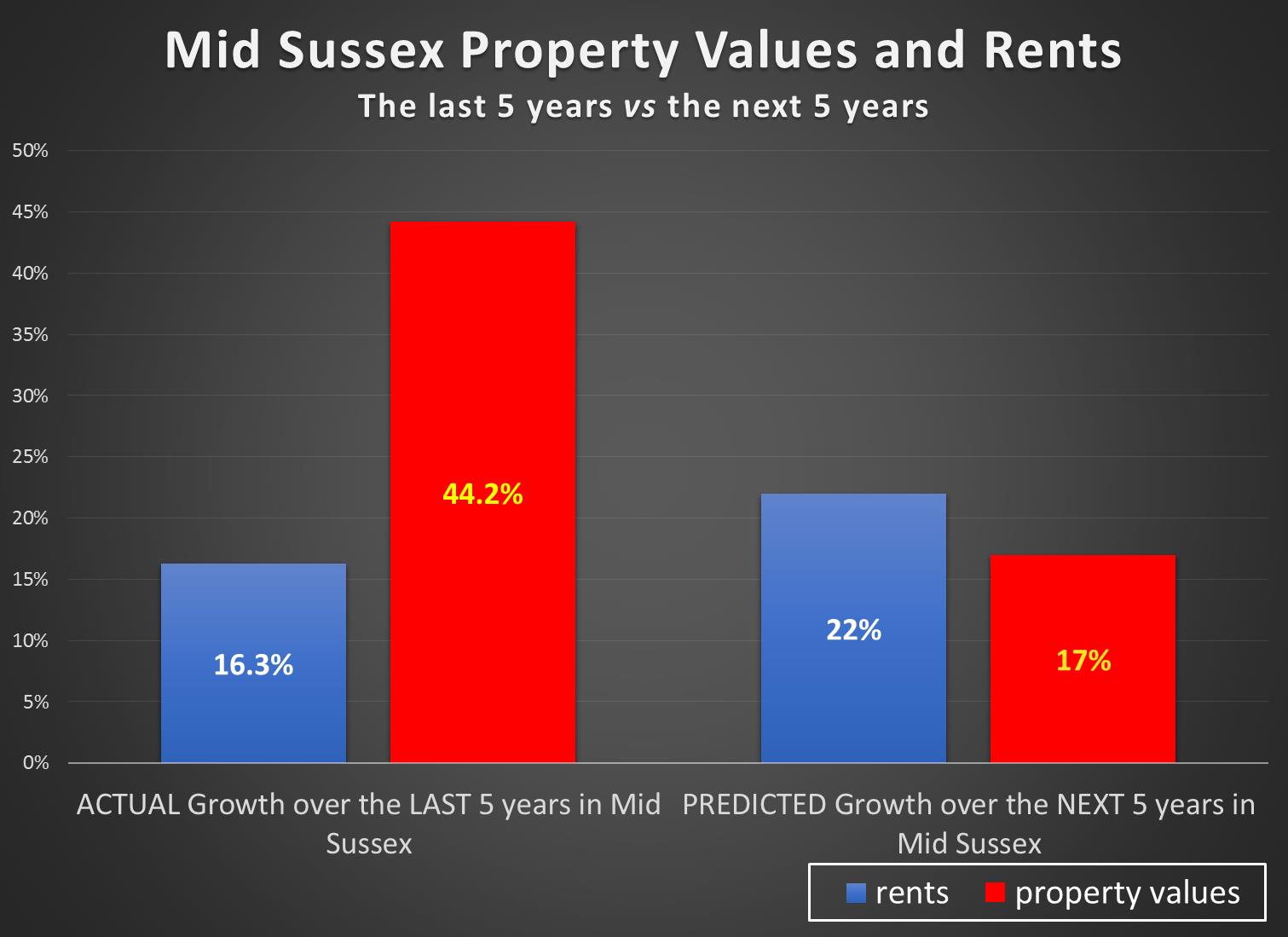
The next five years will see an interesting change in the Mid Sussex property market. My recent research has concluded that the rent private tenants pay in Mid Sussex will rise faster than Mid Sussex property prices over the next five years, creating further issues to Mid Sussex’s growing multitude of renters. In fact, my examination of statistics forecasts that by 2022, Mid Sussex rents will increase by 22%, whereas Mid Sussex property values will only grow by 17%.

Let me explain why I have come to those conclusions:

Over the last five years, property values in Mid Sussex have risen by 44.2% whilst rents have only risen by 16.3%.

 Source: Denton House Research.


Throughout the last few years, and compounded in 2016, tenant demand for rental properties continued to go up whilst the Press predicted some landlords expect to reduce their portfolios in the next couple of years, meaning Mid Sussex tenants will have fewer properties to choose from, which will push rents higher. In fact, talking to fellow property professionals in Mid Sussex, there appears to be privation and shortage of new rental properties coming on to the Mid Sussex lettings market.

Landlords have some intriguing challenges ahead of them in the coming years most notably in that the Tory’s have changed the taxation rules for landlords in the way buy to let properties are to be taxed. On top of that, there is the ban on letting agent fees which is still to come into force (probably in 2018). When that happened in Scotland in 2012, Scottish letting agents passed on those fees to their landlords, who in turn increased the rent they charged to their tenants.

All I would say to Theresa May and Philip Hammond is that they must be wary about indicating both red and green lights at the same time to the private rented sector. They can’t expect the armies of small private landlords to continue to house around a fifth of the population and then tax the hell out of them. They didn’t invest in buy to let as a charity or to satisfy any philanthropic urges. Something has to give – and that will be significant rent rises over the coming few years (and before anyone gives me any derogatory comments about landlords if it wasn’t for landlords buying all these buy to let properties over the last 15 years, I am not sure where everyone would be living today – because most the Council houses were sold off in the 1980’s!).

With the challenges ahead, with the ‘B’ word (that’s budget if you wondered!), house price inflation will be tempered over the coming five years in Mid Sussex. As I have discussed in previous articles, the number of properties on the market in Mid Sussex remains close to historic lows, which is both good as it keeps houses prices relatively stable, yet not so good as it impedes choice for buyers and hence why I believe property values in Mid Sussex will only be 17% higher in five years’ time.

Whilst on the other side of the coin, with the challenges facing landlords and the significant shortage of new homes being built, Mid Sussex people still need somewhere to live. If those people aren’t buying houses and the local authority aren’t building council houses in the thousands (because they have no money), with the average rent for a Mid Sussex rental property currently standing at £1,228 per month Over the next five years, I predict the average rent in Mid Sussex will rise to £1,498 per month.

These are interesting times. There is still money to be made in buy to let in Mid Sussex – Mid Sussex landlords will just need to be smarter and savvier with their investments. If you are looking for such advice and opinion feel free to drop me a line.