Tuesday, 16 August 2016

The Burgess Hill Love Affair with its 2,900 Terraced Houses.


Call me old fashioned, but I do like the terraced house. In fact, I have done some research that I hope you will find of interest my Mid Sussex property market blog reading friends!

In architecture terms, a terraced or townhouse is a style of housing in use since the late 1600’s in the UK, where a row of symmetrical / identical houses share their side walls. The first terraced houses were actually built by a French man, Monsieur Barbon around St. Paul’s Cathedral within the rebuilding process after the Great Fire of London in 1666.  Interestingly, it was the French that invented the terraced house around 1610-15 in the Le Marais district of Paris with its planned squares and properties with identical facades. However, it was the 1730’s in the UK, that the terraced/townhouse came into its own in London and of course in Bath with the impressive Royal Crescent.

However, we are in Burgess Hill, not Bath, so the majority of our Burgess Hill terraced houses were built in the Victorian era.  Built on the back of the Industrial Revolution, with people flooding into the towns and cities for work in Victorian times, the terraced house offered decent livable accommodation away from the slums. An interesting fact is that the majority of Victorian Burgess Hill terraced houses are based on standard design of a ‘posh’ front room, a back room (where the family lived day to day) and scullery off that.  Off the scullery, a door to a rear yard, whilst upstairs, three bedrooms (the third straight off the second).  Interestingly, the law was changed in 1875 with the Public Health Act and each house had to have 108ft of livable space per main room, running water, its own outside toilet and rear access to allow the toilet waste to be collected (they didn’t have public sewers in those days in Burgess Hill – well not at least where these ‘workers’ terraced houses were built).

It was the 1960’s and 70’s where inside toilets and bathrooms were installed (often in that third bedroom or an extension off the scullery) and gas central heating in the 1980’s and replacement UPVC double glazing ever since.

Looking at the make-up of all the properties in Burgess Hill, some very interesting numbers appear.  Of the 12,602 properties in Burgess Hill;

3,694 are Detached properties (29.3%)
4,269 are Semi Detached properties (33.8%)
2,920 are Terraced / Town House properties (23.1%)
1,708 are Apartment/ Flat’s (13.5%)


And quite noteworthy, there are 11 mobile homes, representing 0.09% of all property in Burgess Hill. 

When it comes to values, the average price paid for a Burgess Hill terraced house in 1995 was £59,550 and the latest set of figures released by the land Registry states that today that figure stands at £249,370, a rise of 319% - that’s not bad at all is it. When you consider apartments in Burgess Hill in the same time frame have only risen by 261%.

But then a lot of buy to let landlords and first time buyers I speak to think the Victorian terraced house is expensive to maintain.  I recently read a report from English Heritage that stated maintaining a typical Victorian terraced house over thirty years is around sixty percent cheaper than building and maintaining a modern house- which is quite fascinating don’t you think!

Tuesday, 9 August 2016

92.5% of Mid Sussex Homeowners are over 35. The affect of their Brexit vote on the Mid Sussex Property Market.


Well it’s been nearly 7 weeks since the Referendum vote and we have had a chance to reflect on the momentous decision that the British public took. Many of you read the article I wrote on the morning of the results. I had gone to bed the night before with a draft of my Remain article nicely all but finished, to be presented, at just after 5am, with the declaration by the BBC saying we were leaving the EU. I don’t think any of us were expecting that.

If you want to read a copy of that original Post Brexit blog post just scroll back to late June to find it. In this article I would like to take my thoughts on from that initial article and now start to see the clearer picture as the dust settles on the UK, but more importantly, the Mid Sussex Property Market.

In case you weren’t aware, the residents of the Mid Sussex District Council area went against the National mood and voted as follows;

Mid Sussex District Council Remain Votes 46,471 (53.1% of the vote)
Mid Sussex District Council Leave Votes 41,057 (46.9% of the vote)

Mid Sussex District Council Turnout; 80.7%

I have been reading there is some evidence to indicate younger voters were vastly more likely to vote remain than their parents and grandparents. Whilst the polling industry's techniques may have been widely criticised, following them getting both the 2010 General Election and the recent Brexit vote wrong, anecdotally, many surveys seem to suggest there was a relationship between age and likelihood to support leaving the EU.

Interestingly, the average age of a Mid Sussex resident is 41 years old, which is above the national average of 39.3, which might go some way to back up the way Mid Sussex voted? What I do know is that putting aside whether you were a remain or leave voter, the vote to leave has, and will, create uncertainty and the last thing the British property market needs is uncertainty (because as with previous episodes of uncertainty in the UK economy – UK house prices have tended to go down).

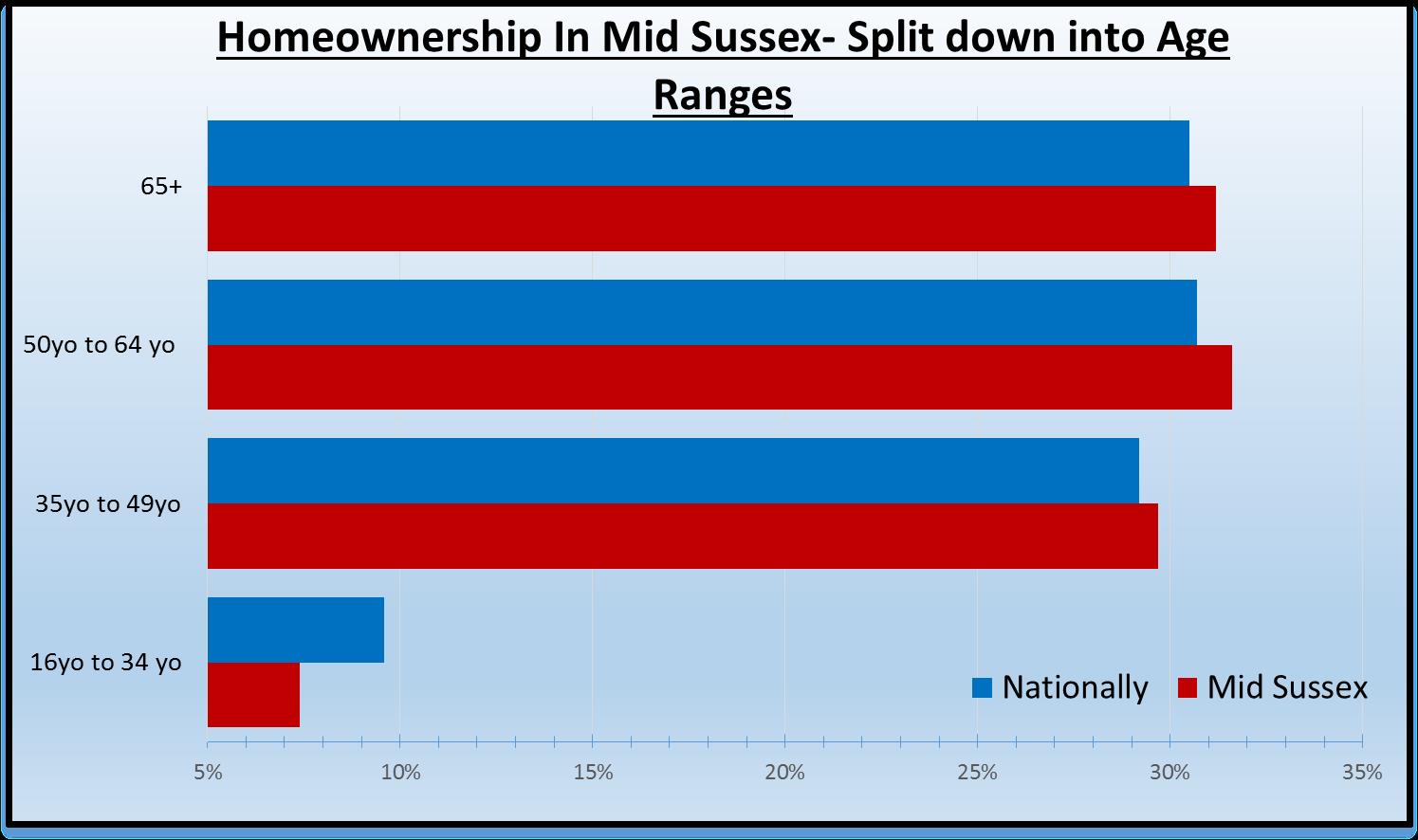
Interestingly, when we look at the home-ownership rates in the Mid Sussex District Council area, of the 43,219 properties that are owned in the Mid Sussex District Council area (Owned being owned outright, owned with a mortgage or shared ownership), the age range paints a noteworthy picture.

   Age 16 to 34 homeowners 3,215 or 7.4% (Nationally 9.6%)
Age 35 to 49 homeowners 12,833 or 29.7%   (Nationally 29.2%)
Age 50 to 64 homeowners 13,679 or 31.6%   (Nationally 30.7%)
             Aged 65+ homeowners 13,492 or 31.2% (Nationally 30.5%)


So, looking at these figures and the high proportion of older homeowners, you might think all the Mid Sussex District Council area homeowners would vote Remain to keep house prices stable and younger people would vote out so house prices come down- so they could afford to buy.

But there's a risk in oversimplifying this. The sample of the polling firms are in the thousands whilst the country voted in its millions. Other demographic influences have been at play in the way people voted, as early evidence is starting to suggest that class, level of education, the levels of immigration and ethnic diversity had an influence on the way the various parts of the UK voted.

So what I suggest is this – Don’t assume everyone over the age of 50 voted ‘Leave’ and don’t assume most 20 somethings backed ‘Remain’; because many didn't!

Wednesday, 3 August 2016

Great yield. Great location!


Good Morning to my blog reading fans, I was checking what has come to the market, as I do over a coffee every morning, and this little rental gem popped up. On the market with Moore & Partners in Crawley this lovely one bed flat in Handcross is well priced at £160,000. You can view the details by clicking here.


It is very well presented and looking at the photos could be rented without doing any work. It is perfect for commuting due to its proximity to the main A23 and would be attractive to Gatwick workers. Rental wise I would be looking at around £750 PCM, which at the guide price of £160,000 gives an impressive yield of 5.6%. The property is leasehold, so make sure you check out the service charges and ground rent carefully, as this will have an effect on any yield.

If you are considering a buy to let investment you are welcome to call in to my Martin & Co office on Keymer Road for a coffee and a chat, or email me if you have any questions.

Tuesday, 2 August 2016

Population in Mid Sussex area set to rise to 170,700 by 2036.


Mid Sussex faces a predicament. The population is growing and the provision of new housing isn’t keeping up. Take Burgess Hill for example, with the average age of a Burgess Hill person being 41.0 years (compared to the South East average of 40.0 years old and the national average of 39.4 years of age). The population of Burgess Hill is growing at an alarming rate. This is due to an amalgamation of longer life expectancy, a fairly high birth rate (compared to previous decades) and high net immigration, all of which contribute to housing shortages and burgeoning house prices.

Durham University has kindly produced some statistics specifically for the Mid Sussex District Council area. Known as the UK’s leading authority for such statistics, their population projections make some startling reading.

For the Mid Sussex District Council area these are the statistics and future forecasts

2016 population           146,799
2021 population           153,426
2026 population           159,833
2031 population           165,480
2036 population           170,709


The normal ratio of people to property is 2 to 1 in the UK, which therefore means we need just under 12,000 additional new properties to be built in the Mid Sussex District Council area over the next 20 years.

Whilst focusing on population growth does not tackle the housing crisis in the short term in Burgess Hill, it has a fundamental role to play in long-term housing development and strategy in the town. The rise of Burgess Hill property values over the last six years since the credit crunch are primarily a result of a lack of properties coming onto the market, a lack of new properties being built in the town and rising demand (especially from landlords looking to buy property to rent them out to the growing number of people wanting to live in Burgess Hill but can’t buy or rent from the Council).

Although many are talking about the need to improve supply (i.e. the building of new properties), the issue of accumulative demand from population growth is often overlooked. Nationally, the proportion of 25-34 year olds who own their own home has dropped dramatically from 66.7% in 1987 to 43.8% in 2014, whilst 78.2% of over 65s own their own home. Longer life expectancies mean houses remain in the same hands for longer.

The swift population growth over the last thirty years provides more competition for the young than for mature population.  It might surprise some people that 98% of all the land in the UK is either industrial, commercial or agricultural, with only two percent being used for housing, which means one could propose expanding supply to meet a expanding population by building on green belt – that most Politicians haven’t got the stomach to tackle, especially in the Tory’ strongholds of the South of England, where the demand is the greatest. People mention brownfield sites, but recent research suggests there aren’t as many sites to build on, especially in Burgess Hill that could accommodate 12,000 properties in the next 20 years.

In the short to medium term, demand for a roof over of one’s head will continue to grow in Burgess Hill (and the country as a whole). In the short term, that demand can only be met from the private rental sector (which is good news for homeowners and landlords alike as that keeps house prices higher).

In the long term though, local and national Government and the UK population as a whole, need to realise these additional millions of people over the next 20 years need to live somewhere. Only once this issue starts to get addressed, in terms of extra properties being built in a sustainable and environmentally friendly way, can we all help create a socially ecological prosperous future for everyone.